

Professor Jorge Majfud, Argentina 01/2026
When the Global Is More Local Than the Local: Jorge Majfud at UNC on the Global Roots of Urban Segregation
Universidad Nacional de Córdoba, Argentina.
At the “Cities of Care” conference in Córdoba, Argentina, the Jacksonville University professor argued that no city can be understood, designed, repaired, or lived in by looking only at itself. The following is a summary based on the transcript of his October 1, 2026, presentation.
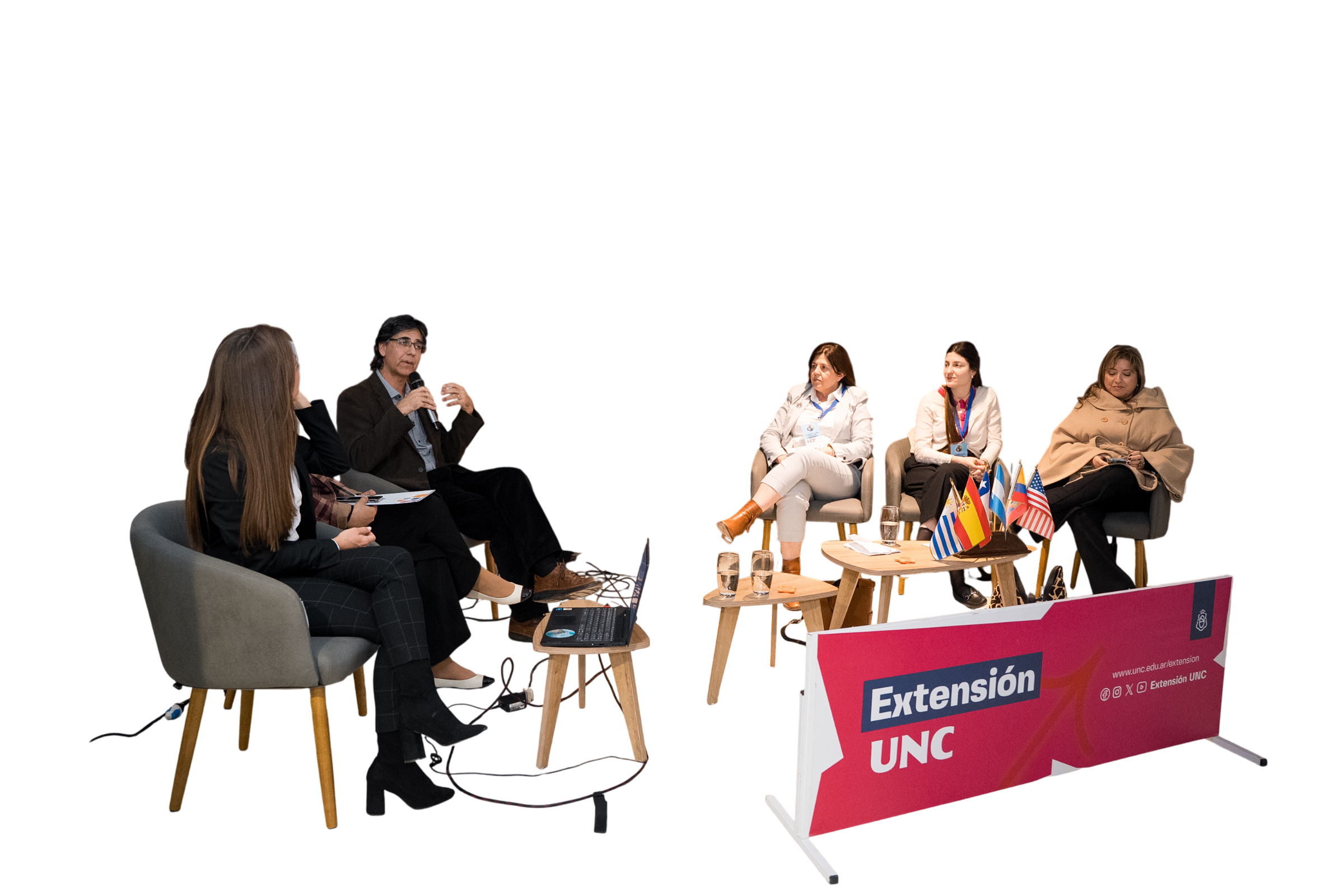 Centro Cultural UNC, Córdoba, October 1, 2026
Cordoba, Argentina: The conference Transformar el Estado desde lo local: ciudades del cuidado, innovación pública y cooperación internacional took place October 1 and 2 at the Centro Cultural UNC. Dr. Jorge Majfud, a professor at Jacksonville University, participated in the thematic panel Ciudades del cuidado: políticas públicas para una sociedad más inclusiva (“Cities of care: public policy for a more inclusive society”), moderated by Milagros González. His presentation, Segregación urbana y arquitectónica (“Urban and architectural segregation”), traced five centuries of inequality and exclusion as they have been written into the physical form of cities.
The conference was organized by the Universidad Nacional de Córdoba’s Secretaría de Extensión in cooperation with the Mercociudades network, the Government of Catalonia’s delegation for the Southern Cone and the Municipality of Córdoba. Vice-Rector Mariela Marchisio, Secretary Alberto Ambrosio, Secretary of Extension Conrado Storani, Coordinator of the Permanent Secretary of Mercociudades Jorge Rodríguez and Josep Vives i Portell opened the event. Participating cities also signed the Compromiso de las ciudades con los cuidados, a commitment to developing policies centered on care. Florencia López Foresi, a member of the organizing team, moderated the afternoon strategic panel on local governments and the global agenda.
Professor Majfud shared the panel with Cristina Nallino of the Municipalidad de Cordoba, Mariela Couto of Mercociudades, and Myrian Martínez from Fundación Mediterránea. He began with the origins of the modern concept of race and pointed to figures such as the Roman emperor Septimius Severus, born in North Africa, whose surviving representations and contemporary accounts did not generally classify him through the modern racial categories familiar today. He also mentioned Alessandro de’ Medici, known as “Il Moro,” who became Duke of Florence in 1532. The modern racial category, he argued, was codified later and eventually presented as respectable science during the nineteenth century.
For Majfud, race was never simply opposed to abstract, impersonal capitalism. It developed alongside it and became one of the mechanisms through which the emerging economic order organized labor, property, and power. Racial classification transformed human beings into inheritable property and helped establish a new form of slavery in which status was passed from one generation to another. It also served to reinforce the growing concentration of social, political, and narrative power in the hands of those who controlled money —the ideological core of capitalism.
The contradiction became sharper when revolutions and abolitionist movements began challenging what American slaveholders called the “peculiar institution,” which they portrayed as the only institution capable of protecting civilization and expanding freedom, even as industrial societies in Europe and the United States confronted their own forms of class segregation. Formerly enslaved people were becoming citizens, at least in law, and acquiring some rights that had previously been denied to them.
The response from those who benefited from the old order was not limited to resistance to abolition. It included segregation, racial theories, organized forms of hatred, and a return to indenture or “voluntary slavery,” the most common today. Under slavery, Majfud argued, Black men and women could live inside white households and communities as servants without necessarily being regarded as political equals. The analogy he offered was deliberately provocative: people do not hate their washing machines or microwaves because they do not regard them as citizens capable of questioning any social order. The sharper conflict emerged when the servant became, in law, an equal.
That loss of privilege helped produce new forms of racial ideology, he argued, and those ideas were eventually expressed not only through laws and social customs but through the physical organization of cities.
Majfud connected this history to what he described as the contemporary “Dark Enlightenment,” which he said combines attacks on the Native American experience that radically influenced European debates about democracy and equality before the birth of the Enlightenment with renewed defenses of patriarchy and machismo today. In this vision, he argued, hierarchy is presented as a more efficient alternative to democratic institutions. Its preferred model is the large corporation: a vertical organization with limited democratic accountability and little transparency. A hierarchy sustained by concentrated wealth, social segregation, neo colonization, renewal of national fragmentations, apartheid, and renewed forms of racial and gender supremacy.
Since around 2010, Majfud has described this tendency as “Neo feudalism”, a return to medieval forms of hierarchy, connecting it to contemporary discussions of Techno feudalism and the privatization of governance. He suggested that the language of the “smart city” can sometimes conceal the same political logic behind a new technological vocabulary.
From there, Majfud’s argument moved from ideology into space. The slave ship Brookes, he suggested, can be understood as an early example of racial architecture: a physical structure designed around the classification and control of human beings. Colonial cities continued the process. In Luanda, for example, the Portuguese established a spatial division between the upper city and the lower port. Fortifications and commercial settlements along the West African coast similarly reflected the economic and racial hierarchies of colonial rule. Apartheid later transformed such divisions into an explicit system of territorial planning, transportation and residential segregation.
Majfud turned to redlining in the US, describing it as “the map as a sentence.” Federal housing maps classified predominantly Black neighborhoods as high-risk areas, restricting access to mortgages, insurance and investment. The maps did not always need to state explicitly that an area was Black or white. Economic classifications could accomplish much the same thing.
Majfud called this “euphemistic urbanism”: discrimination expressed through apparently neutral categories such as property values, credit risk and neighborhood conditions. Financial institutions could then reproduce the boundaries established by the maps.
The Fair Housing Act of 1968 formally prohibited housing discrimination, but the legacy of redlining did not disappear. In 2023, for example, the U.S. Department of Justice reached a redlining settlement with Ameris Bank involving lending practices in Jacksonville. The geography of the case, Majfud noted, overlapped with areas that had been identified as high-risk in earlier housing maps.
Highways provided another instrument of urban separation. Majfud showed how Interstate 95 contributed to the transformation of LaVilla in Jacksonville, once a major center of Black life and culture often referred to as the “Harlem of the South.” He placed Jacksonville within a broader American pattern that included Overtown in Miami, where highway construction displaced thousands of residents, as well as Black Bottom in Detroit, Rondo in Saint Paul, Hayti in Durham, Claiborne Avenue in New Orleans and Greenwood in Tulsa. In Tulsa, he observed, “what violence did not erase, infrastructure divided.”
He also discussed Robert Moses and the Cross Bronx Expressway, which cut through a working-class section of the Bronx and displaced residents and businesses. The highway became a landmark example of how transportation infrastructure can reinforce existing social divisions and generate new ones. Interstate highways did not simply follow an inevitable technical logic. Their routes were economic and political decisions. In Jacksonville and elsewhere, projects that were presented as solutions to traffic and modernization could simultaneously destroy established neighborhoods, weaken local businesses and accelerate demographic change. Decades later, the Bronx neighborhoods around the Cross Bronx Expressway had become predominantly Black and Latino, because lower housing costs attracted residents with fewer economic options.
Architecture, in this sense, is both the product of segregation and one of the mechanisms through which segregation survives. The built environment becomes a kind of fossil record of political decisions that may have been made generations earlier.
But the central point of Majfud’s presentation was methodological. At a conference concerned with transforming the state and strengthening communities “from the local,” he questioned the tendency to treat each place, or each government decision, as an isolated problem that can be understood or solved without first considering its global, historical, and de facto ideological context. Those forces do not remain abstract: they become embedded in the physical organization of society. A building may reflect the preferences of an individual owner, but urban planning is political —it is about the polis. The decisions that determine where people live, how they move, and which neighborhoods receive investment often have histories that extend far beyond the boundaries of the places where their consequences are ultimately felt.
The same logic that shaped nineteenth-century Jerusalem before the British Mandate, colonial Luanda and twentieth-century Detroit can be traced in Buenos Aires, where major infrastructure projects have repeatedly intersected with poor and marginalized communities, including Villa 31. It can also be found in contemporary “smart cities,” which Majfud warned may turn citizenship into a subscription service while transferring functions of government to private corporations.
Majfud also addressed why debates over inequality and segregation provoke such strong reactions. “Cities are not machines; they are political animals,” he said. People, he argued, often react more intensely to the loss of privileges than to the loss of rights. Rights are supposed to be shared; privileges are experienced as personal advantages. When those advantages are threatened, the reaction can become defensive and, historically, violent.
He suggested that this dynamic is visible again in the territorial politics of the contemporary far right, where struggles over neighborhoods, borders, migration and public space are increasingly tied to broader battles over who belongs and who has the right to shape the future of a city.
Majfud closed his presentation with a line from his 2009 novel The City of the Moon: “We inhabit the cities of the dead, and their ideas inhabit us every day.”
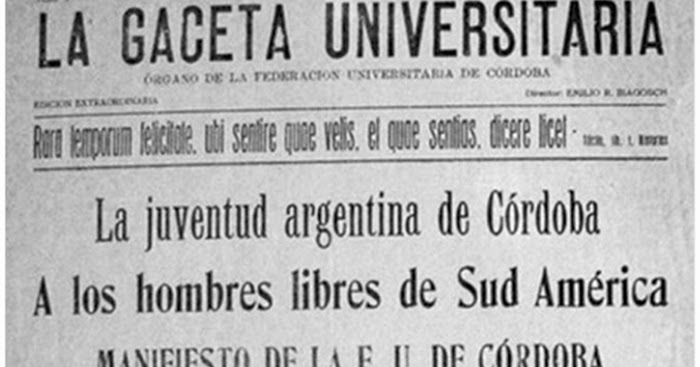 La Gaceta Universitaria, organ of the Federación Universitaria de Córdoba, special
edition of June 21, 1918. It carried the Manifiesto Liminar by Deodoro Roca, "to the free men of South America," under a line from Tacitus celebrating the rare times when one may "think what one wishes and say what one thinks."
La Gaceta Universitaria, organ of the Federación Universitaria de Córdoba, special
edition of June 21, 1918. It carried the Manifiesto Liminar by Deodoro Roca, "to the free men of South America," under a line from Tacitus celebrating the rare times when one may "think what one wishes and say what one thinks."
The location itself carries deep historical weight. Established by the Jesuits in 1613, the Universidad Nacional de Córdoba stands as Argentina’s oldest university (and one of the oldest across the Americas) with its historic Jesuit Block recognized as a UNESCO World Heritage Site. Yet its true turning point occurred in 1918, when students rebelled against a deeply entrenched, clerical, and aristocratic establishment. On June 15, they seized control of the campus. Their defining manifesto, drafted by Deodoro Roca and addressed “to the free men of South America,” proclaimed: “We have just broken the last chain that, in the middle of the twentieth century, bound us to the old monarchic and monastic domination,” reminding readers that “the pains that remain are the freedoms still missing.” That uprising secured university autonomy, co-governance between students and faculty, open faculty hiring, and academic freedom, a model that quickly rippled across the continent from Uruguay to Lima to Havana and Mexico City. Today, over a century later under Rector Jhon Boretto, the university continues its legacy of free, public higher education. It proved an ideal backdrop for discussing how privilege gets built into urban architecture —and how that structure can be taken apart.
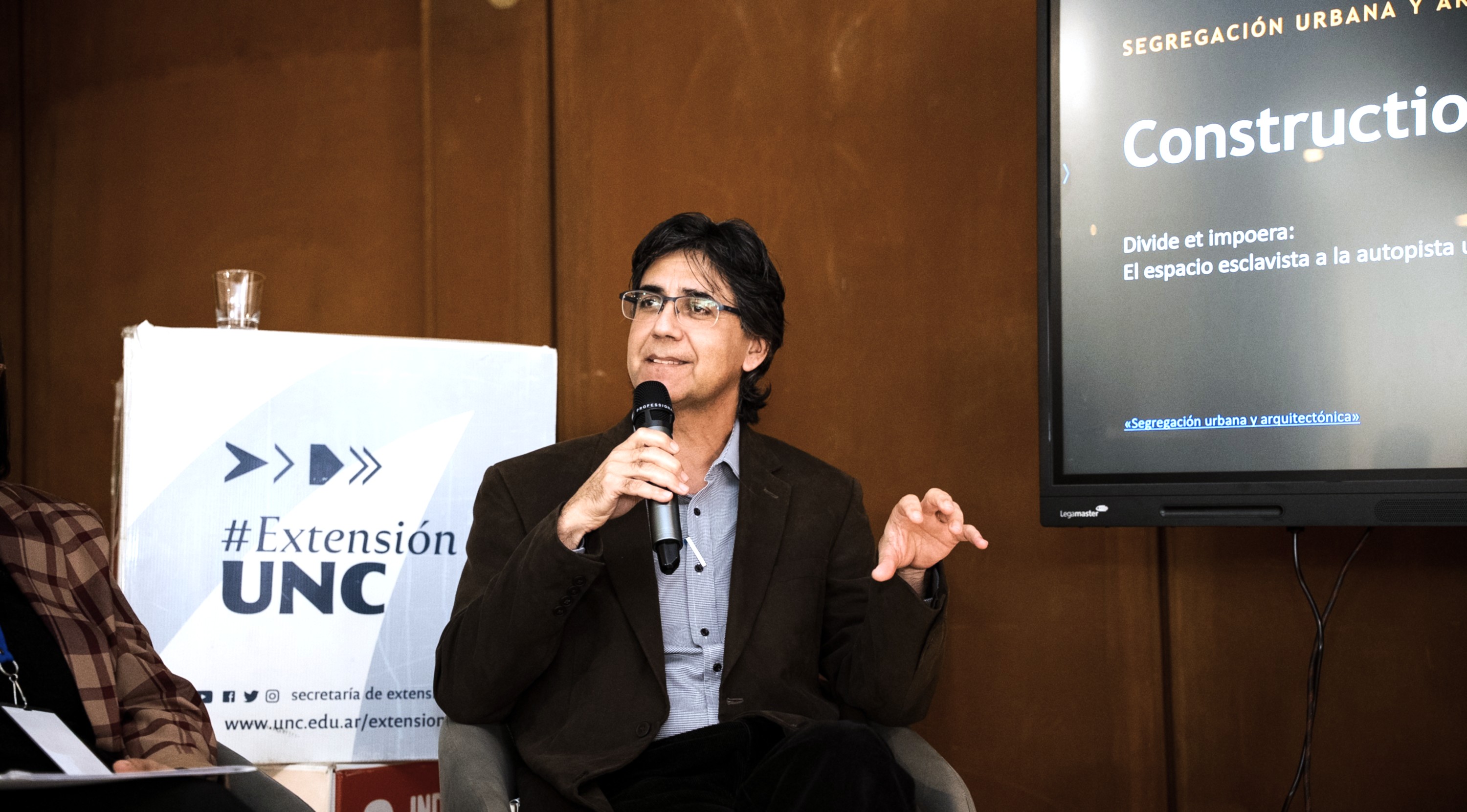

Florencia López Foresi. Master’s degree in International Studies. Areas of specialization: International Cooperation, Global Partnerships, Project Development, and Higher Education.