As a choreographer, Dr. Christina Teague-Mann is fascinated by how the body seems to know what to do next as it encounters the world. Her choreography creates situations in which performers must sense, respond, adapt, negotiate their environments and often improvise movement in real-time. That led her to ask the question: What might choreographic understandings of embodiment contribute to robotics research?
A Thesis Project Supervisor for Jacksonville University’s Master of Fine Arts in Choreography, Dr. Teague-Mann has been challenging student choreographers to push their medium forward and think outside the box for more than two decades. She’s been a pivotal player in the development of JU’s low-residency MFA program and has personally supported and supervised more than 140 student projects. Her work, in the classroom and in the dance studio, leads choreographers to test the limits of what their discipline can become.
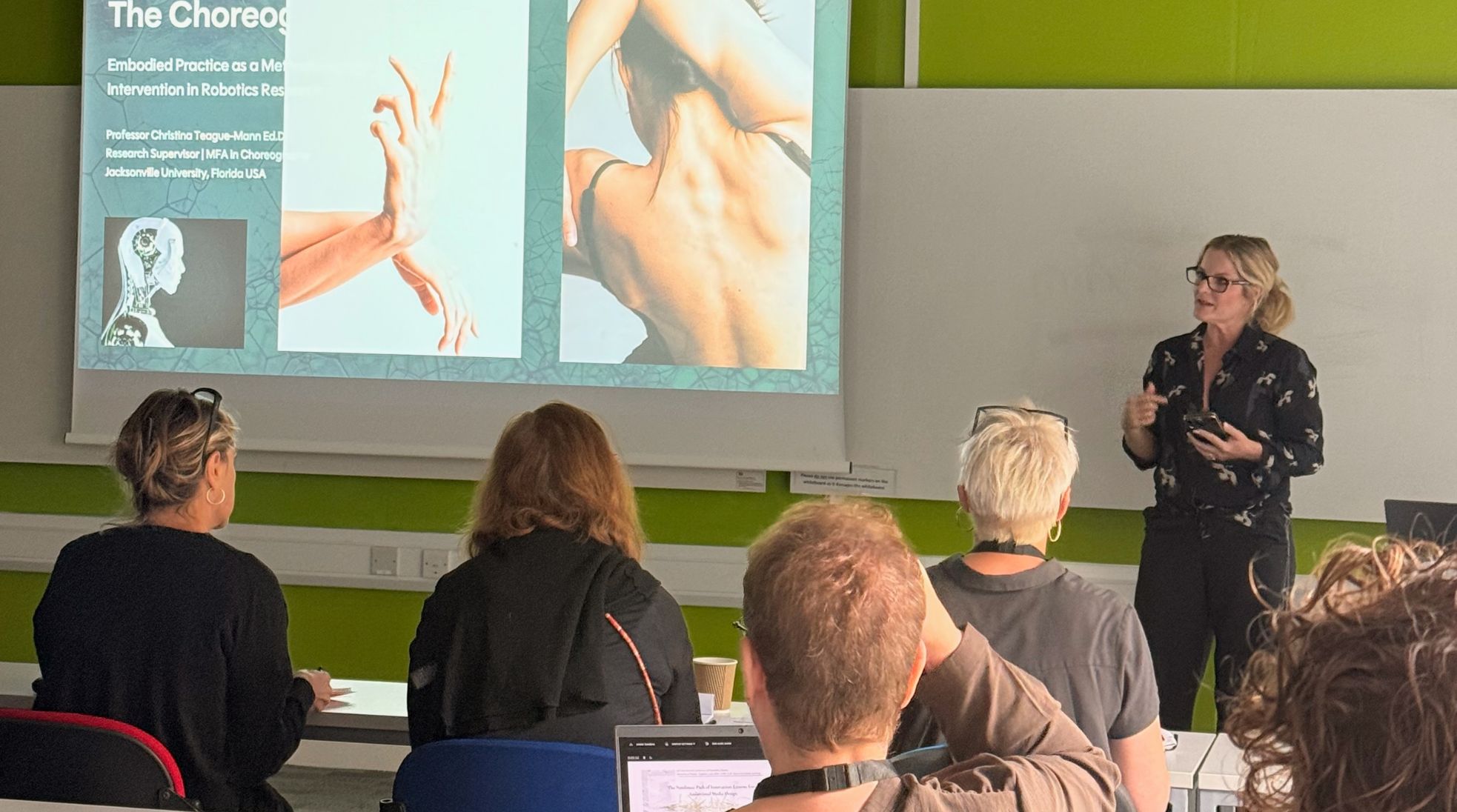
This summer, she presented an original research paper at the 6th Annual Possibility Studies Conference at the University of Sussex in England, making the case that choreographic expertise belongs in robotics research and development. The paper, titled "The Choreographic Lead: Embodied Practice as a Methodological Intervention for Robotics Research and Development," argues that choreographers bring a body of knowledge, developed through generations of working with human bodies, perception, movement, environment and adaptation, that could contribute meaningfully to how researchers investigate human-robot interaction. For Dr. Teague-Mann, the experience reinforced the notion that in dance and in academia, you do not always know where your discipline is going to take you.
“Education should give you enough depth in your own field that you have something meaningful to bring into conversations with people whose expertise is completely different from yours,” said Dr. Teague-Mann.
In that spirit, the choreography program deliberately resists a single model. Some students work through systematic investigation. Others lead with intuition and artistic exploration. And others pursue Practice as Research, where the creative process itself becomes the primary site of inquiry. What they all share is a mentor who pushes them to create their best work without ever trying to make one student’s work look like another’s.
“If we give students strong expertise in their own disciplines while also creating opportunities for them to work across disciplinary boundaries, we are not trying to predict every profession they may eventually enter,” said Dr. Teague-Mann. “We are preparing them to enter changing environments with something distinctive to contribute and with the ability to recognize possibilities that may not yet have a name.”
For JU students, Dr. Teague-Mann's journey from the dance studio to the robotics lab is proof that a deep education in any discipline can open doors that have not yet been built. The possibilities, as she would say, are still being discovered.